



RATEC Laval nozzles get far more velocity out of your compressed air than a simple nozzle can. Their special shape first narrows the airflow and then widens it again in a controlled way, so the air is deliberately accelerated and the flow in your pneumatic conveying system becomes more efficient. Every Laval nozzle is a custom component: we design it for your application, air pressure and air volume and supply it ready to install.
Table of Contents
How Laval nozzles work
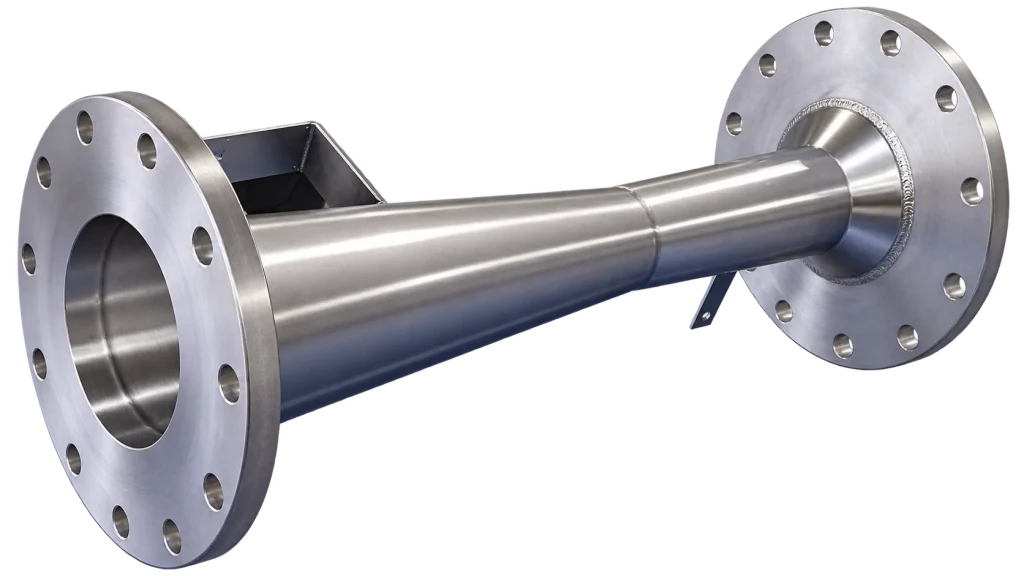
A Laval nozzle consists of three sections. In the converging part, the cross-section narrows and the air speeds up. At the narrowest point, the throat, it reaches the speed of sound if the pressure ratio is high enough. In the following diverging part, the air does not slow down again but keeps accelerating into the supersonic range. A simple nozzle that only converges, by contrast, reaches its limit at the speed of sound. The design is named after the Swedish engineer Gustaf de Laval.
Where Laval nozzles are used
Laval nozzles are a component that we use, depending on the application, wherever air needs to be accelerated or metered precisely. One example is our airflow control systems for the conveying air. A special effect helps here: once the air reaches the speed of sound at the throat, the flow rate depends only on the upstream pressure and no longer on the back pressure downstream. This keeps the air volume stable, even when the pressure in the conveying line changes. Where exactly a Laval nozzle sits in your plant is defined during the design phase.
Your benefits
- More velocity: the pressure energy of the air is converted into flow velocity.
- Efficient flow: an even, directed air jet with low losses.
- Constant air volume: independent of back pressure once the throat reaches the speed of sound.
- No moving parts: robust and low-maintenance.
Key technical data
| Feature | Laval Nozzles |
|---|---|
| Principle | converging and diverging cross-section (convergent divergent) |
| Application | depending on the application, e.g. in airflow control systems for the conveying air |
| Design | e.g. nozzle body turned from solid with a welded-on flange |
| Medium | compressed air or other gases |
| Geometry, connections, dimensions | individual for each application |
| Materials | stainless steel, other materials depending on requirements |
| Special versions | on request |
We design cross-sections, opening angles and connections for each project. The designs shown are examples, and other designs are always possible.
What matters in the design
- Air supply: available upstream pressure, air volume, gas used.
- Application: required jet velocity, back pressure at the outlet, installation situation.
- Bulk material: particle size, abrasiveness, sensitivity to attrition.
- Environment: temperature, hazardous area.
Custom-built by RATEC
RATEC is at home in bulk material handling and manufactures at its own plant in Carinthia, Austria, certified to ISO 9001, EN 1090-1 and ISO 3834-2, from one-off pieces to small series. We bring experience from the chemical, food, building materials and energy industries. As a custom component, no two Laval nozzles are alike. The photos on this page show example designs from customer projects, and your solution is developed from scratch to your requirements. You can find all custom components at a glance under Custom Components.
Want to get more out of your conveying air?
Tell us your application, air pressure and air volume. We will get back to you with a specific proposal.