



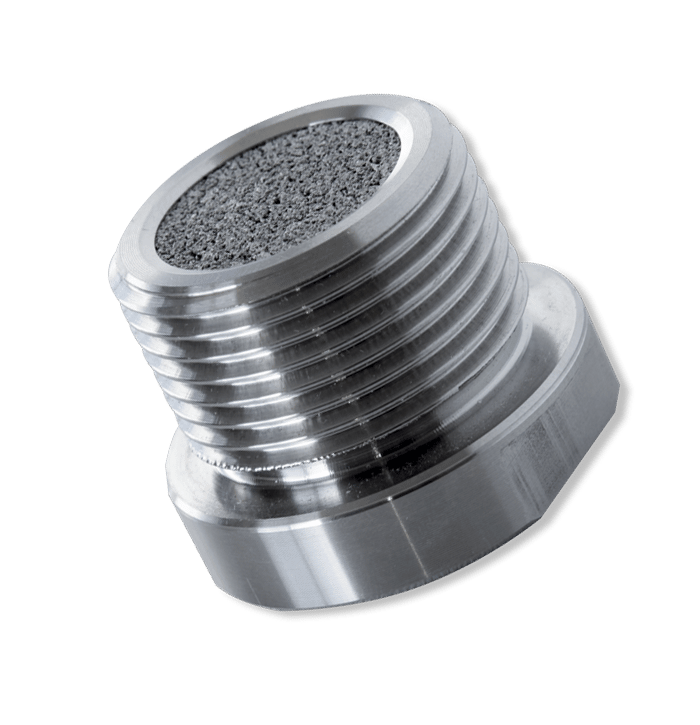
The RATEC KBSS-50 sinter ventilation nozzles are made of highly porous stainless steel and distribute air finely into silos and containers, loosening the bulk material so it does not bridge. They have a size of Ø 2″, are easily screwed in via a threaded socket, and are available in three identically designed sizes. The corrosion-resistant stainless steel is sturdy, durable, and operates silently, making it ideal for chemical and pharmaceutical applications as well as abrasive bulk materials.
Table of Contents
How sinter ventilation works
The air flows through the porous sintered stainless steel body and exits into the bulk material finely distributed over its surface. The product is loosened, or fluidized; clumps and bridges dissolve, and the bulk material flows evenly out of the cone again.
Technical Data KBSS-50
| Feature | KBSS-50 |
|---|---|
| Design | Nozzle with socket |
| Size | Ø 2″ |
| Installation | Threaded socket, screwed in |
| Connection | 1/4″ |
| Material | Stainless steel 1.4305 / 1.4404 |
| Options | ATEX-compliant version, FDA-compliant product-contact materials, on request |
The specified sizes are standard; other sizes and materials are available on request.
Your benefits
- High air permeability: uniform, fine air distribution in the product.
- High strength: robust even with abrasive bulk materials.
- Corrosion-resistant stainless steel: durable and silent.
- Simply screwed in: Installation via the threaded socket.
- Three sizes: identical design in Ø 1″, 2″ and 3″.
Other sizes and designs
The KBSS-50 is also available in identical designs in sizes KBSS-25 and KBSS-80. Other sintered metal designs include the Sinter Ventilation Nozzle KBDS-25 and the Sinter Ventilation Nozzle with Flange KSS-80. If you’re looking for a flexible, self-closing solution, check out the Silicone Ventilation Nozzles. You can find an overview of all ventilation systems under Ventilation Systems.
Which ventilation is right for your silo?
Tell us your bulk material, installation location, and operating conditions. We will recommend the design, size, and number of ventilation elements.