

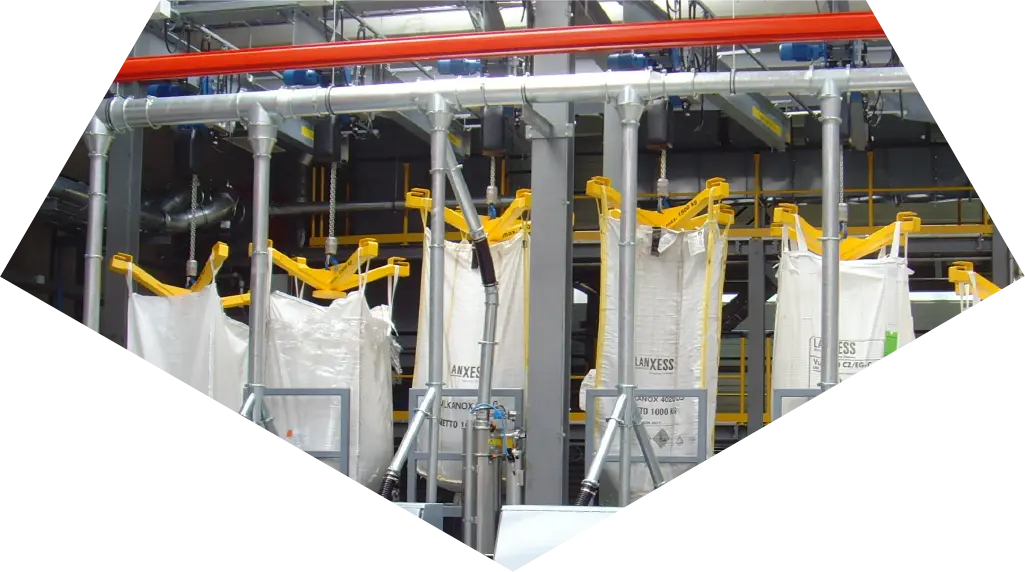
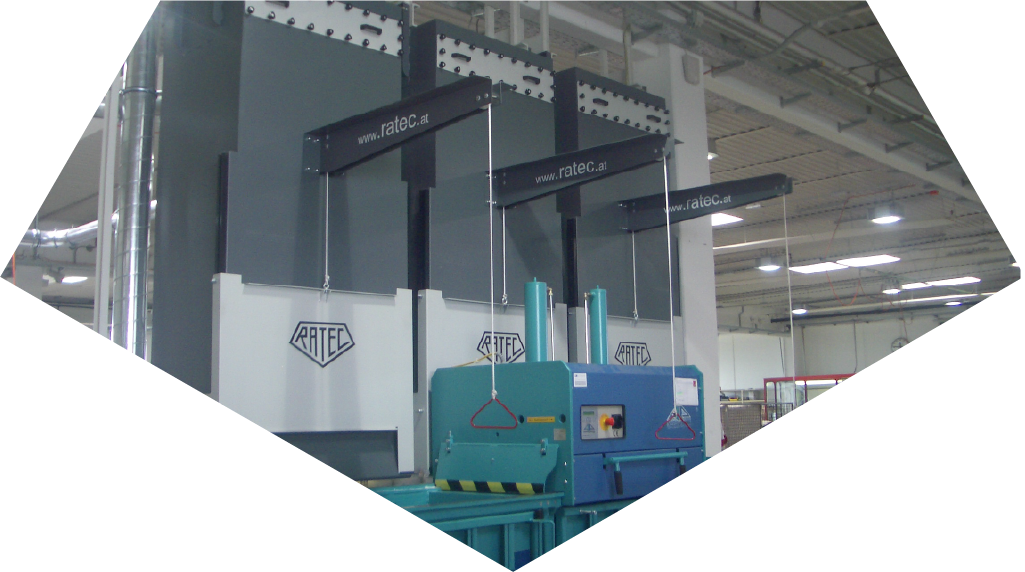

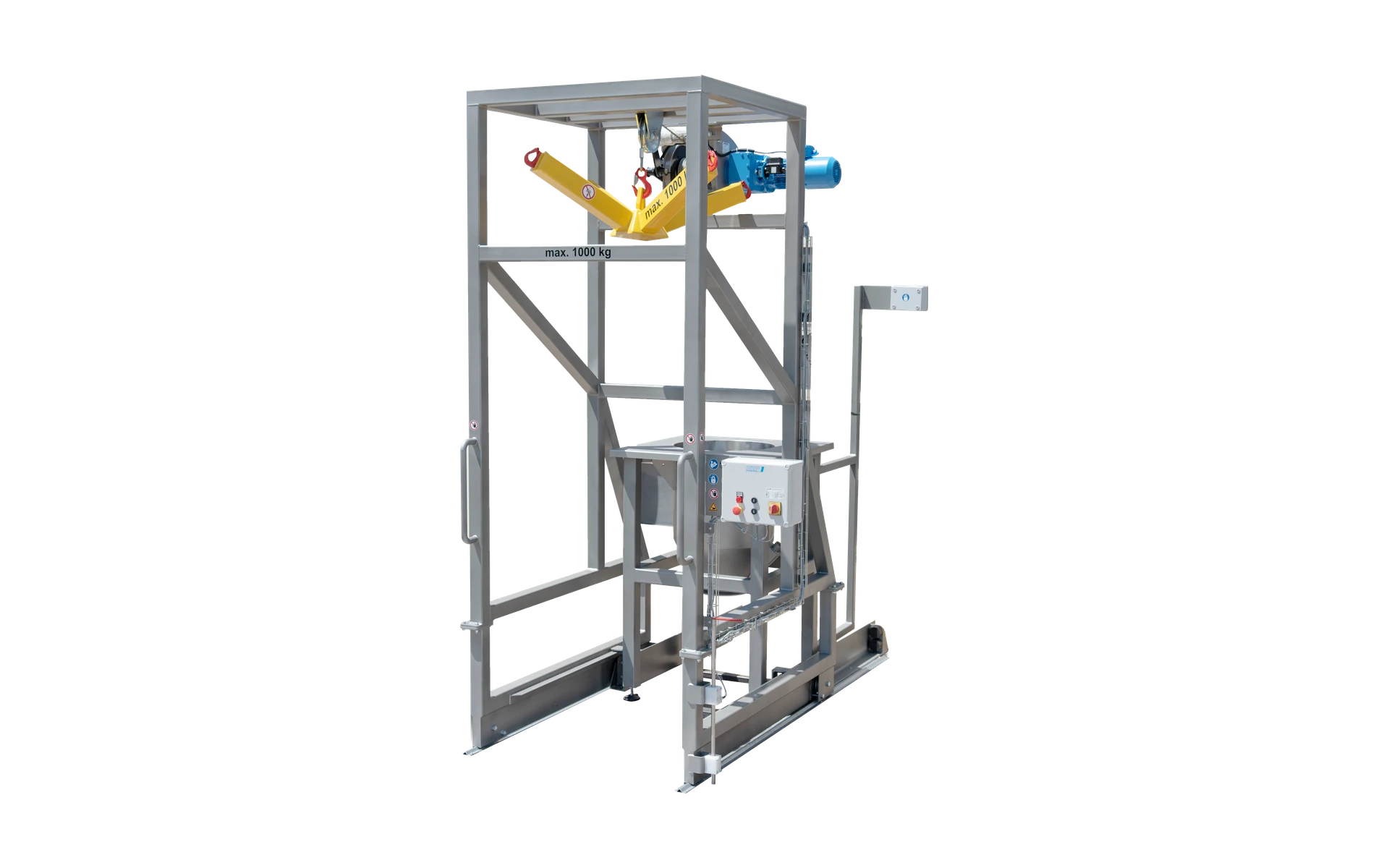
RATEC Big Bag discharging stations are complete systems for the low-dust discharging of powders and granulates from big bags. An electric chain hoist with load beam lifts the big bag and sets it onto the docking unit, and thanks to a particularly low overall height, the stations also fit where little installation space is available. On request, we add hoppers, screens, or other components, and on request also in ATEX- and FDA-compliant versions. RATEC develops and manufactures every discharging station in-house in St. Veit an der Glan.
Table of Contents
How Big Bag Discharging Stations Work
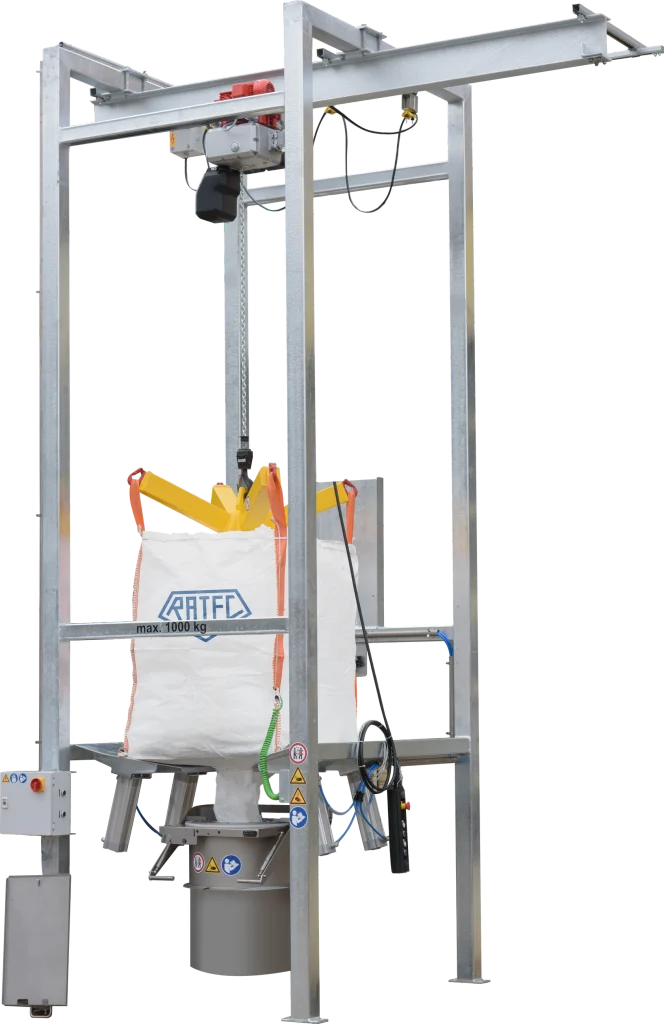
- Lifting: The electric chain hoist picks up the full big bag with the load beam and lifts it into the station.
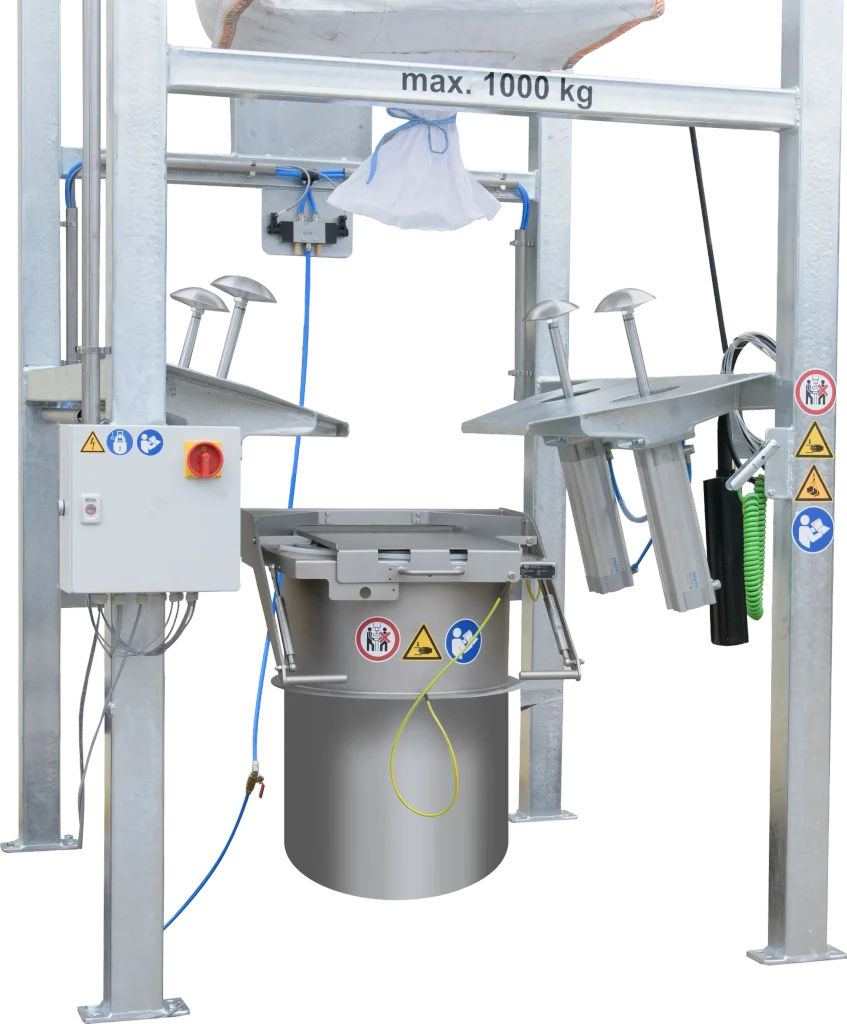
- Docking: The big bag is set onto the docking unit, where its discharge spout is sealed tightly in place.
- Discharging: The bulk material flows in a controlled manner through the hopper into your process, without dust escaping.
- Residual Discharging: For poorly flowing products, pneumatic pistons or vibration motors are available on request to fully empty the big bag.
Afterward, the empty big bag is released and removed with the electric chain hoist. The station is ready for the next one.
Why Low Overall Height Matters
Big bag discharging stations often need to fit into existing buildings, where height is frequently the limiting factor. Above the station, space is needed for the chain hoist, load beam, and the raised big bag; below it, for the hopper and the connection to your process. Every centimeter the station itself saves creates room for big bag size, hoisting equipment, and connections.
RATEC discharging stations are therefore deliberately built with a low profile. This allows them to be used in existing plants and under low ceilings, without needing to modify the overhead crane or the building.
Why Discharge with Low Dust?
Open discharging of big bags quickly creates a dust cloud. This burdens the air at the workplace, soils the building and equipment, and wastes product. With combustible dusts, there is also the risk of an explosive atmosphere. Because the discharge spout is sealed tightly at the docking unit, the dust stays within the system. This improves air quality, reduces health risks, and keeps the work environment clean, with less effort and less material loss.
Equipment and Options
- Electric Chain Hoist with Load Beam: included in the scope of delivery, for safely lifting and positioning the big bag.
- Docking Unit: seals the discharge spout tightly, operated manually or mechanically.
- Hoppers and Screens: for a controlled transition into your process.
- Discharge Aids: pneumatic pistons or vibration motors for complete residual discharging.
- Robust Construction: made of high-strength stainless steel, with ergonomic working height, emergency stop, and stable mounting.
- ATEX and FDA: on request for hazardous areas, food, and pharmaceutical applications.
We tailor dimensions, chain hoist, and equipment to your process and your space conditions. We manufacture other sizes and versions to your specifications.
Discharging Station, Discharge Unit, or Docking Unit?
RATEC offers low-dust discharging in three configuration levels:
- Docking Units: the tight connection between big bag and process, for installation into your existing system.
- Discharge Units: the pure unit consisting of frame, big bag support, and docking unit, without hoisting equipment and load beam.
- Discharging Stations: complete systems with electric chain hoist, load beam, and docking unit. With these, you lift and discharge big bags using a single system.
Which level is right for you depends on whether you already have hoisting equipment for your big bags and how much space is available.
Use in Hazardous Areas
For hazardous areas, RATEC supplies the discharging stations in ATEX-compliant versions, with the docking unit fully grounded throughout. Equally important is the right big bag: conductive Type C big bags, which must be grounded, or antistatic Type D big bags are commonly used. This classification is described in the standard IEC 61340-4-4.
What Matters in the Design
- Bulk Material: powder, granulate, or dust and its flow behavior.
- Throughput: how many big bags are discharged per hour or shift.
- Space Conditions: installation space, building height, existing crane or forklift.
- Big Bag Size: dimensions and weight of the full big bags.
- Special Requirements: ATEX, FDA, automation, screens, or custom versions.
Where Big Bag Discharging Stations Are Used
RATEC big bag handling systems are used in the pharmaceutical industry, the food industry, fine and heavy chemicals, the building materials industry, and the plastics industry. Discharging stations are typically installed where raw materials are transferred from big bags into mixers, containers, dosing systems, or conveyor lines. In combination with an inlet closure, it can additionally be ensured that only the correct product enters the container.
Custom-Built by RATEC
RATEC is at home in the bulk material sector and manufactures components for bulk material systems in its own plant in Carinthia, certified to ISO 9001, EN 1090-1, and ISO 3834-2. We coordinate overall height, chain hoist, docking unit, hopper, and screens as a complete system tailored to your process and your space conditions. You can find an overview of all products under Big Bag Handling.
Planning a Big Bag Discharge?
Tell us briefly about your bulk material, your big bags, and your space conditions. We will get back to you with a concrete solution proposal.