

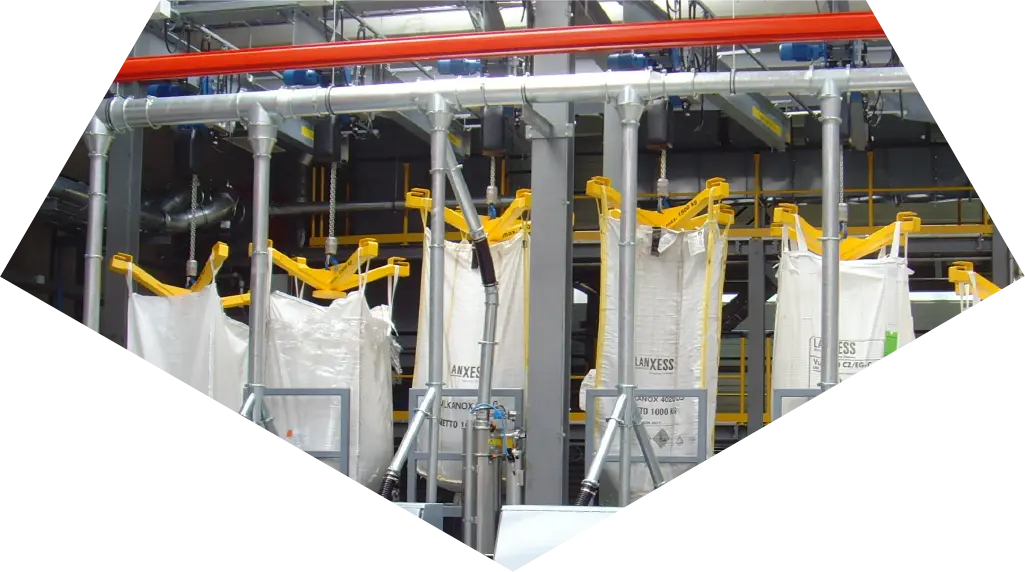

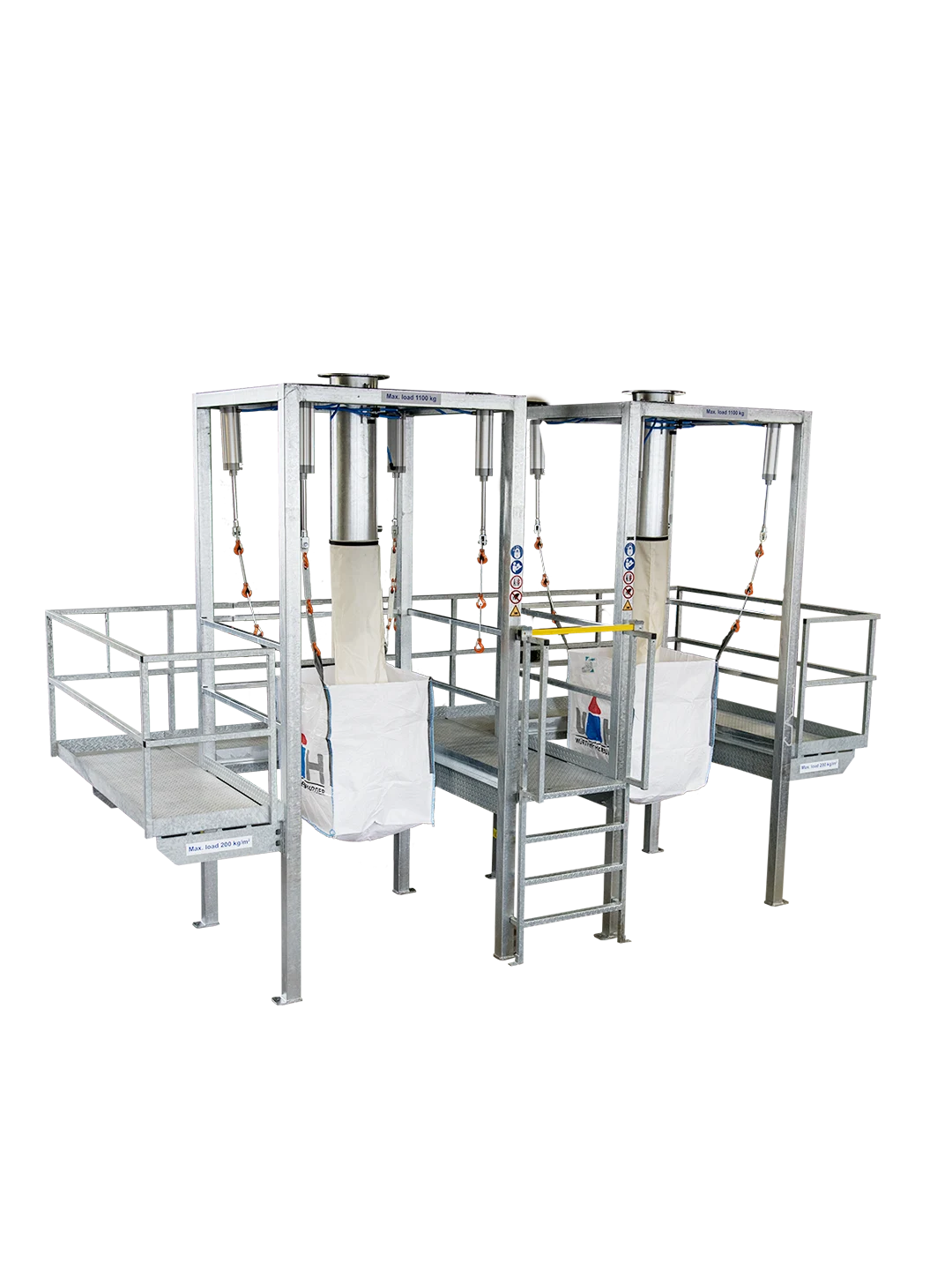
RATEC Big-Bag filling stations fill powders, granules, and dusts cleanly and with low dust into Big-Bags, as a single station or as multiple stations for higher throughputs. Each station is custom-designed for your bulk material, your Big-Bag formats, and your filling process, from simple applications to complex production workflows. Upon request, we supply the filling station in an ATEX-compliant version and with FDA-compliant, product-contacting materials. RATEC develops and manufactures every station in-house in St. Veit an der Glan.
Table of Contents
How the Big-Bag Filling Station Works
- Hooking up: The empty Big-Bag is hooked up to the station and its filling spout is connected to the filling head.
- Filling: The bulk material flows guided through the filling head into the Big-Bag. Because it does not fall freely, significantly less dust is generated during filling.
- Detaching and transporting: The full Big-Bag is detached from the filling head, sealed, and transported further with a forklift or crane and lifting beam.
The detailed structure of the station depends on your process. We will determine the operation, degree of automation, and equipment together with you.
Single Station or Multiple Station?
A single station fills one Big-Bag after another. It is compact, quickly integrated into existing workflows, and the right choice if filling is not the bottleneck of your process.
A multiple station offers several filling positions, for example, as a double station with two positions. While one Big-Bag is being filled, another can already be changed at the next position. This reduces waiting times and is suitable for higher throughputs, for multiple products, or for systems where the product flow should not be interrupted.
Which version is suitable depends on throughput, available space, and your shift operation. We will advise you on this during the design phase.
Why Low-Dust Filling?
When filling Big-Bags, dust is generated, especially with fine powders. Guided filling via the filling head improves air quality at the workplace, reduces health risks, and keeps the hall and system clean. At the same time, precise filling ensures fewer losses and less material waste. For your personnel, this means less cleaning effort and faster, error-free filling.
Equipment and Features
- Robust: Construction made of high-strength stainless steel, designed for continuous operation.
- Ergonomic: Working height and controls are arranged so that hooking up and changing Big-Bags is easy.
- Operation as needed: manual, mechanically assisted, or pneumatic.
- Safe: Emergency stop and stable fastening are included.
- Options on request: Scale for weighing, compaction of bulk material, and vibrating floors.
- Compact: The station can be easily integrated into existing processes and storage areas.
We adapt all features to your requirements. Dimensions, number of filling positions, and equipment depend on your process.
What Matters for Design
To ensure the filling station suits your process, we clarify the following with you in advance:
- Bulk material: Powder, granulate, or dust and its properties, such as flow behavior and dust tendency.
- Throughput: How many Big-Bags are to be filled per hour or shift.
- Space requirements: Installation space, hall height, and whether a crane or forklift is used.
- Big-Bag size: Dimensions and weight of the filled Big-Bags.
- Fill quantity and compaction: whether weighing is required and whether the bulk material in the Big-Bag needs to be compacted, for example, with a vibrating floor.
- Special requirements: ATEX, FDA, automation, or special designs.
Filling in Potentially Explosive Areas
When filling Big-Bags with flammable dusts, electrostatic charge can build up. For these cases, RATEC supplies the filling station in an ATEX-compliant version. Equally important is the suitable Big-Bag: Conductive Big-Bags of type C, which must be grounded, or antistatic Big-Bags of type D are common. The classification is described in standard IEC 61340-4-4. We will clarify which combination is suitable for your product during the design phase.
Part of a Coordinated Overall System
The filling station is the first step in Big-Bag handling. RATEC also supplies the subsequent steps and coordinates everything: lifting beams for safe lifting, emptying stations and docking devices for dust-free emptying, as well as the inlet closure, which only allows the correct product into your container.
Where Big-Bag Filling Stations Are Used
RATEC Big-Bag handling systems are used in the pharmaceutical industry, food industry, fine and bulk chemicals, building materials industry, and plastics industry. Filling stations are typically located at the end of a production line, under silos and mixers, or in storage and logistics centers where bulk material is filled into Big-Bags for shipping.
Custom-Made by RATEC
RATEC is at home in the bulk material sector and manufactures components for bulk material systems in its own plant in Carinthia, certified according to ISO 9001, EN 1090-1, and ISO 3834-2. Each filling station is built to your specifications, from simple single stations to complex multiple systems, including special designs. An overview of all products can be found under Big-Bag Handling.
Are You Planning a Big-Bag Filling Operation?
Briefly describe your bulk material, your Big-Bags, and your throughput. We will get back to you with a concrete solution proposal.