

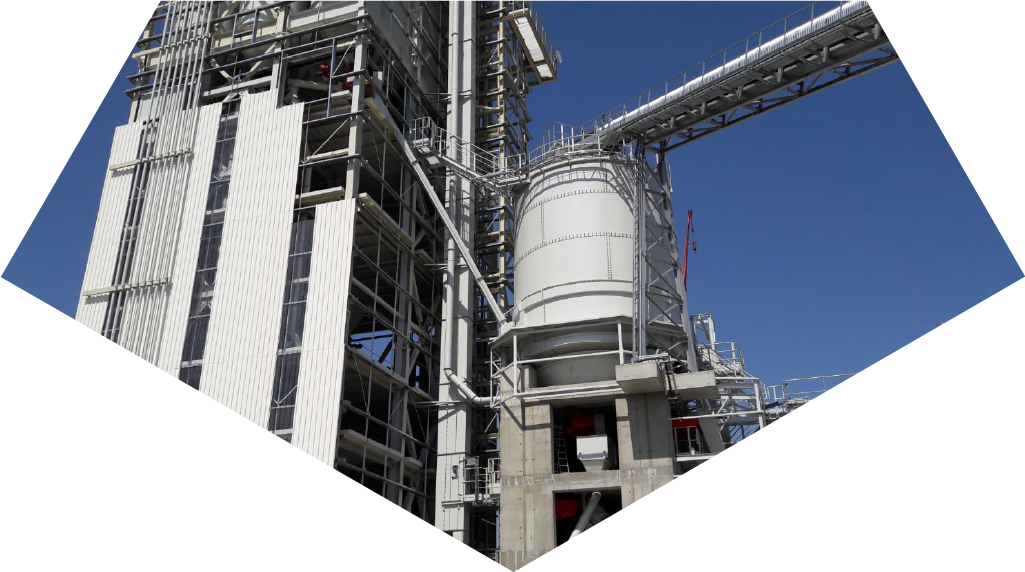
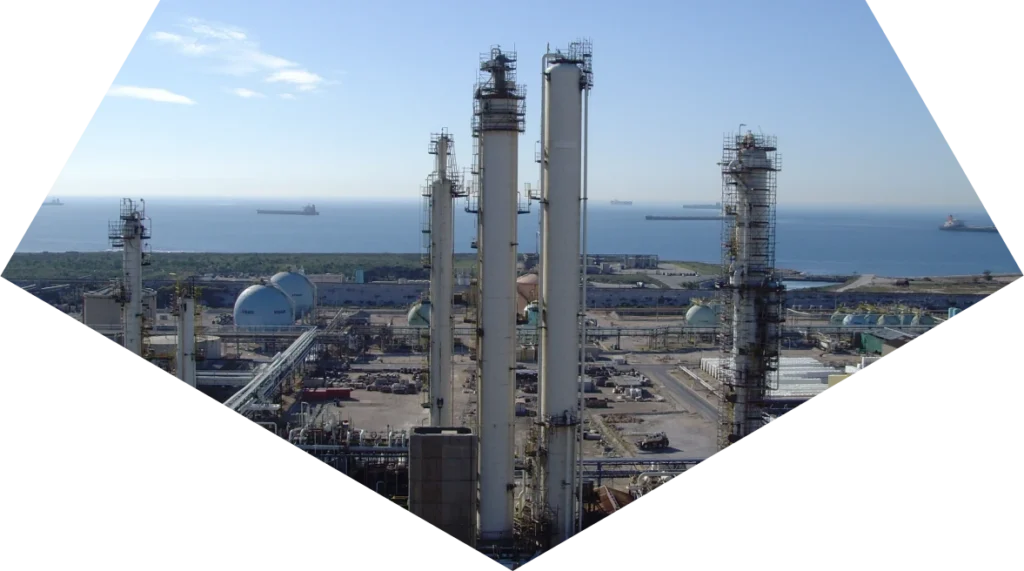
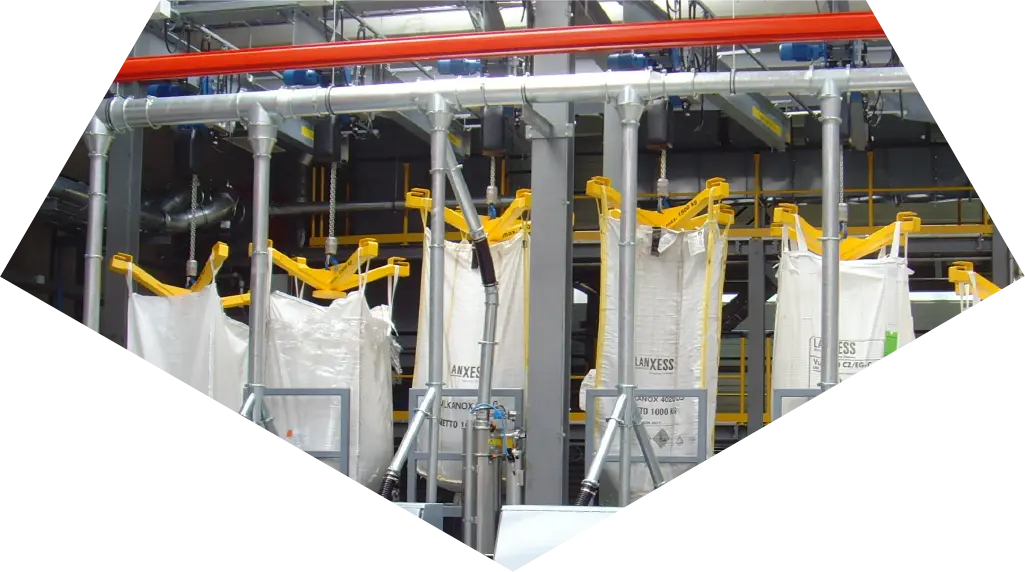
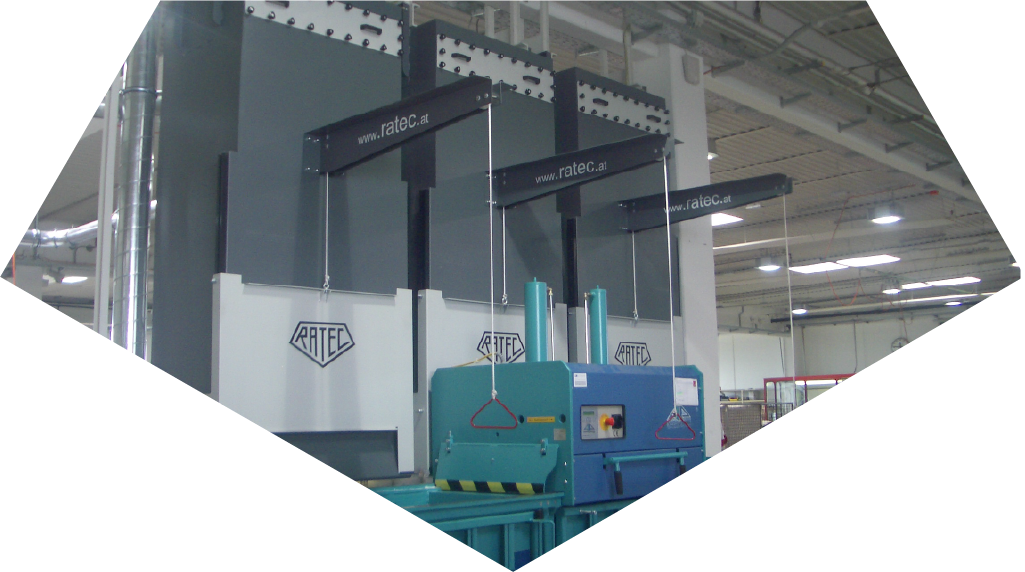


RATEC cyclone filters separate dust from air without any moving parts: the rotation of the air alone flings the particles outward and lets them sink downward. They work especially efficiently at high air volumes, relieving downstream filters of a large share of the dust load. We design the geometry, size, and configuration entirely around your process and manufacture the sturdy steel housing in-house at our plant in St. Veit an der Glan.
Table of Contents
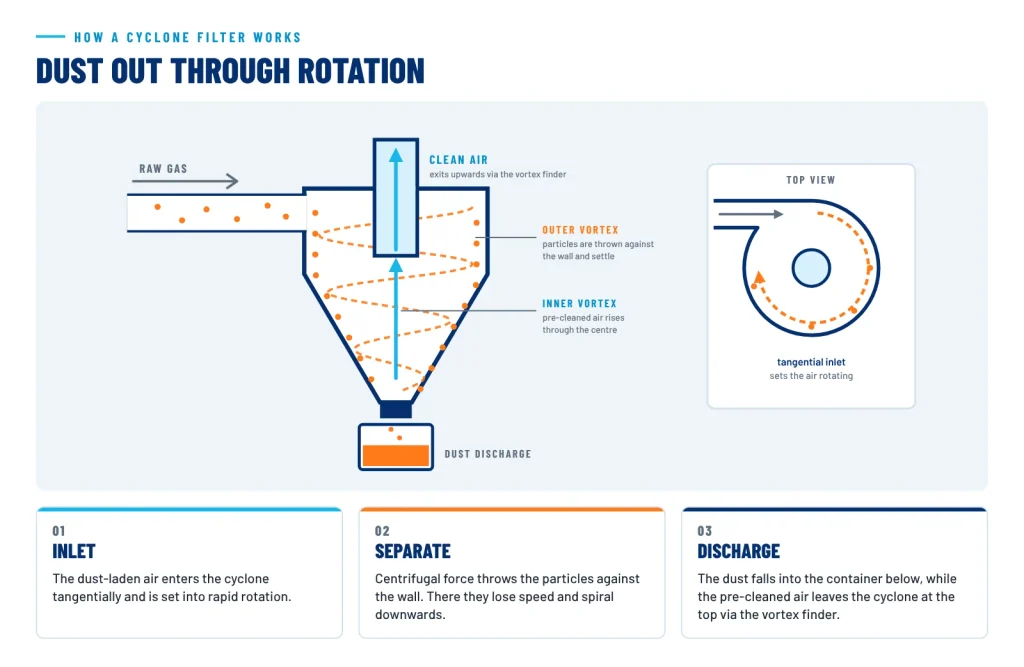
How cyclone filters work
- Inlet: The dust-laden air flows tangentially into the cyclone, setting it into rapid rotational motion.
- Separation: Centrifugal force carries the particles outward to the wall. There, they lose speed and spiral downward.
- Discharge: The dust is discharged at the bottom, while the pre-cleaned air exits the cyclone at the top through the vortex finder.
The larger and heavier a particle is, the more reliably it is separated. The cyclone reliably removes coarse and medium fractions from the airstream. For the finest dust, a cartridge filter or a HEPA filter is therefore usually added downstream.
Where cyclone filters are used
Cyclone filters are used wherever large amounts of dust occur in high air volumes, for example in bulk material handling, metal processing, and waste management. They serve as pre-separation in extraction systems or separate the conveyed material from the air during pneumatic conveying.
Your benefits
- Efficient at high air volumes: reliably separates large amounts of dust.
- Relieves downstream filters: longer service life, fewer filter changes.
- Durable and low-maintenance: no moving parts, robust steel housing.
- Precisely tailored to your process: geometry designed for the specific application.
Technical specifications
| Feature | Cyclone Filters |
|---|---|
| Principle | Cyclone effect, tangential inlet, and rotation |
| Loading | Coarse and fine dust separation, pre-separation |
| Housing | sturdy steel housing |
| Design | flow-optimized, application-specific geometry |
| Industries | Bulk material handling, metal processing, waste management |
| Sizes, configurations, materials | designed individually to your requirements |
What matters for the design
- Dust: particle size, density, quantity, abrasiveness, tendency to adhere.
- Air volume: volume flow and permissible pressure drop.
- Discharge: how the separated dust is collected or conveyed onward.
- System: downstream filter stages, space, fire and explosion protection.
Complete solution from a single source
RATEC supplies cyclone filters individually or as part of a complete extraction system, from consultation and planning to technical design, manufacturing, installation, and commissioning. As a first cleaning stage, we also offer pre-separators in gravity or cyclone configurations. We manufacture in-house at our plant in Carinthia, certified to ISO 9001, EN 1090-1, and ISO 3834-2.
Need to reliably separate large volumes of dust?
Tell us the type of dust, air volume, and location of use. We will get back to you with a concrete proposal.