

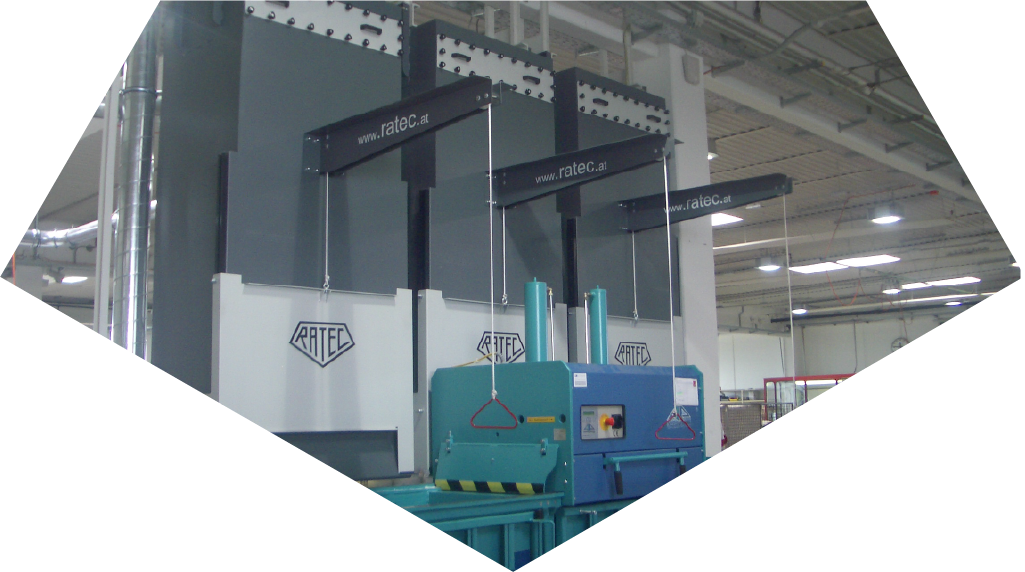

The paper strip extraction system from RATEC conveys tissue trim from the machine into a container with low dust levels, reliably separating air and material. This project demonstrates how electrostatically charged lightweight materials can be filled cleanly and safely into existing container systems. We planned, designed, and manufactured the system at our own plant in St. Veit an der Glan.
Table of Contents
The Task
Paper strips and trim are produced during tissue processing. They are very light, become electrostatically charged, and quickly kick up dust during filling. A stationary solution was required to automatically extract the material, fill it into standard 1,000-liter containers, and keep the surrounding environment dust-free.
The filling process
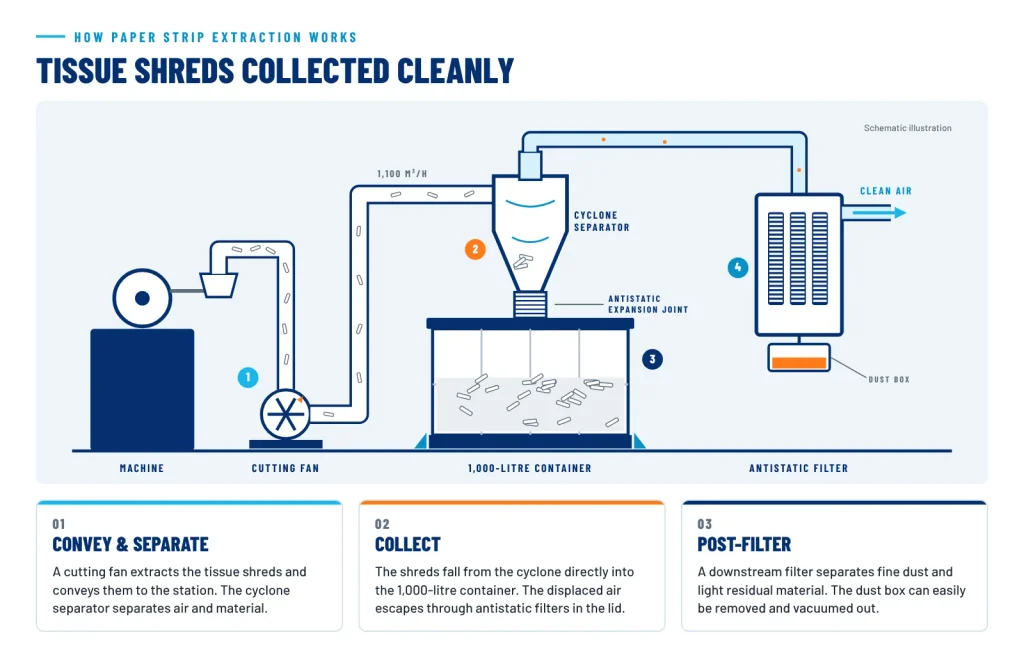
- Conveying: A cutting fan extracts the tissue trim and conveys it to the station with low dust levels.
- Separation: A cyclone separator separates the air from the conveyed material.
- Collection: The material falls directly into a 1,000-liter container. It is manually docked and precisely aligned using a positioning guide.
- Post-filtration: An antistatic filter separates fine dust and light residual material from the exhaust air.
Details that make the difference
- Viewing window in the lid: Made of laminated safety glass for monitoring the fill level.
- Venting areas with antistatic filters: Displaced air escapes while the dust remains inside.
- Antistatic compensator between lid and cyclone: Compensates for movements and reduces electrostatic charge.
- Generous filter area: For low backpressure within the system.
- Dust collection box at the filter outlet: Simply remove and vacuum out.
Technical specifications
| Feature | Paper Strip Extraction |
|---|---|
| Conveyed material | Tissue trim, paper strips |
| Conveying | Cutting fan |
| Conveying volume | 1,100 Am³/h (actual cubic meters per hour) |
| Separation | Cyclone separator |
| Collection container | 1,000-liter container, manually docked |
| Post-filtration | Antistatic filter with dust collection box |
Transferable to Your Application
This principle is suitable wherever lightweight, fibrous, or electrostatically charged materials are produced, such as edge trims from paper, film, or nonwoven processing. We redesign the conveying volume, containers, filters, and antistatic equipment for every project. You can find more about the separation principle under our filter cyclones; another practical project is our plastic chip extraction.
Complete solution from a single source
From consulting and planning to technical design, manufacturing, assembly, and commissioning: RATEC handles the entire process. You can find more about our approach under Extraction Systems. We manufacture in our own plant in Carinthia, certified according to ISO 9001, EN 1090-1, and ISO 3834-2.
Do you need to extract and fill lightweight materials?
Tell us about your material, quantity, and container. We will get back to you with a specific proposal.