



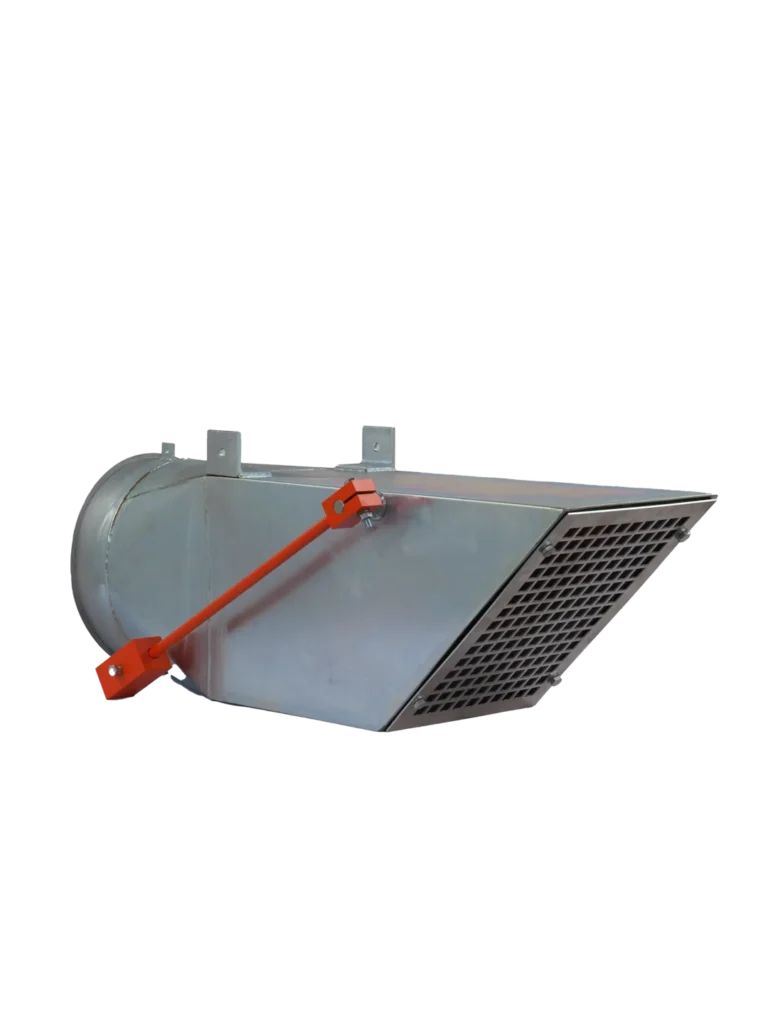
RATEC sniffle valves, also known as air bleed valves or leakage air valves, keep the suction at every extraction point in your system at a constant level. They control the airflow in a targeted way, stop air from being drawn in from unwanted areas and noticeably cut the energy consumption of the entire extraction system. We design every valve for your system and build it at our own plant in St. Veit an der Glan, Austria.
Table of Contents
How sniffle valves work
When individual extraction points in a system are closed, the negative pressure in the ducts rises and the air volume drops. The sniffle valve sits on the duct and, in this situation, lets air in through a grille in a controlled way. An adjustable flap in the housing determines when and how much air flows in. This keeps the air volume and flow velocity in the ducts even, prevents deposits and keeps the fan operating in the right range.
Your benefits
- Constant suction: at every extraction point, even when other points are closed.
- No unwanted airflows: air is drawn in where intended and in a controlled way.
- Less energy: the system runs evenly in its optimum range.
- Robust and simple: sturdy housing, perforated grille, adjustable from outside.
Key technical data
| Feature | Sniffle Valves / Leakage Air Valves |
|---|---|
| Loading | control airflow, keep suction power constant |
| Construction | housing with duct connection, perforated grille, adjustable flap |
| Application | central extraction systems with several extraction points |
| Nominal size, connections, materials | designed individually for your system |
Matching accessories
Sniffle valves complement butterfly valves and intake manifolds in central vacuum systems. We manufacture them at our own plant in Carinthia, certified according to ISO 9001, EN 1090-1 and ISO 3834-2.
Want to stabilise your suction power?
Tell us about your system and the number of extraction points. We will get back to you with a specific proposal.