


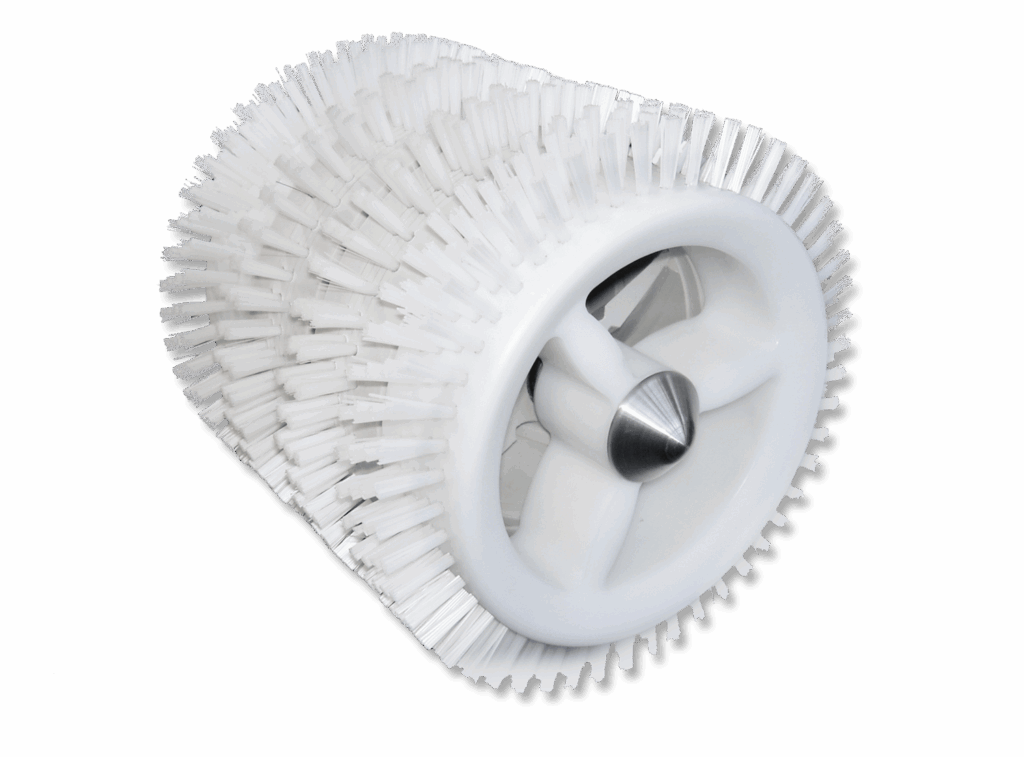
Turbo pigs from RATEC clean pneumatic conveying lines with four brush discs: two rotatably mounted turbine wheels and two fixed-mounted fixed wheels. During the pigging operation, the airflow sets the turbine wheels into counter-rotating motion; the result is a noticeably more thorough cleaning than with simple brush pigs. Turbo pigs are designed for demanding cleaning tasks and large nominal diameters, standard from DN 125. RATEC develops and manufactures every Turbo pig in-house in St. Veit an der Glan.
Table of Contents
How Turbo pigs work
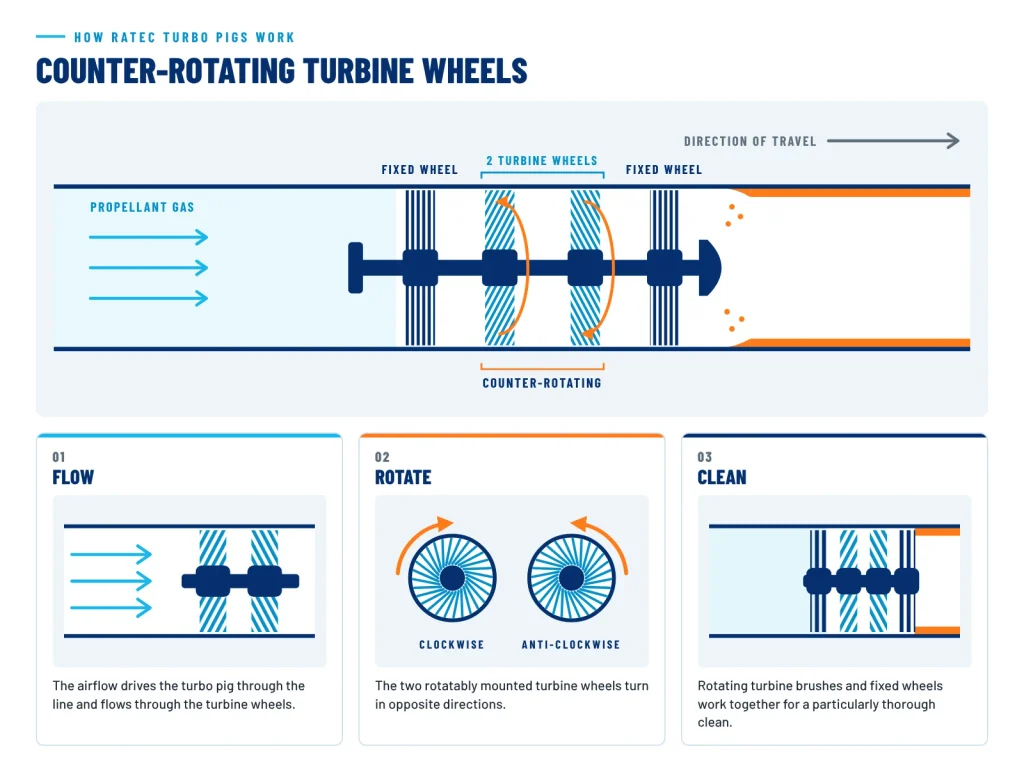
- Inflow: The propellant gas pushes the Turbo pig through the conveying line and flows through the turbine wheels.
- Rotation: The two rotatably mounted turbine wheels are driven by the airflow and rotate in opposite directions.
- Cleaning: Rotating turbine brushes and fixed-mounted fixed wheels work together and clean the pipe wall particularly thoroughly.
Why counter-rotating turbine wheels?
A simple brush pig pushes its bristles along the pipe wall in one direction. Stubborn deposits and fine dust are not always completely captured. With the Turbo pig, a rotational movement is added to the forward movement: the turbine wheels additionally brush the pipe wall transverse to the direction of travel, and because they rotate in opposite directions, the wall is processed from two directions.
The fixed wheels complement the rotating brushes and guide the pig cleanly in the line. This combination of fixed and turbine brushes ensures a cleaning result that cannot be achieved with simple brush pigs. The drive is provided solely by the airflow; a motor or an additional energy source is not necessary.
For large nominal diameters and demanding tasks
Turbo pigs demonstrate their strength primarily in lines from DN 125. With large diameters, the pipe wall to be cleaned is large, and deposits are distributed over a wide circumference. The rotating turbine wheels capture this circumference evenly. Typical applications include lines with highly adhesive products, frequent product changes with high requirements for cleanliness, and systems where simple brush pigs are no longer sufficient.
Disassemblable and repairable with spare parts
Like the modular pig, the Turbo pig is also constructed from individual parts. It can be disassembled, cleaned, and repaired with spare parts. Worn brush discs are replaced, while the rest of the pig remains in use. This keeps running costs low and extends the service life.
Technical specifications
| Feature | RATEC Turbo pigs |
|---|---|
| Construction | 4 brush discs: 2 turbine wheels (rotatable), 2 fixed wheels (fixed), disassemblable |
| Nominal diameter | From DN 125 (standard), other sizes on request |
| Pig speed | 1 to 3 m/s |
| Propellant gas temperature | +5°C to +80°C |
| Drive of the turbine wheels | By the airflow, counter-rotating |
| Conveying type | Pressure and suction conveying |
| Spare parts | Yes, brush discs replaceable |
The values mentioned are our standard design. We manufacture other nominal diameters, materials, and designs according to your specifications. ATEX and FDA-compliant designs are possible for almost all RATEC pigs.
Turbo pig, modular pig, or fixed pig?
- Turbo pigs: with counter-rotating turbine wheels for demanding tasks and large nominal diameters from DN 125.
- Modular pigs: made of replaceable brush discs, flexibly adaptable to the line.
- Fixed pigs: one-piece and robust, the economical solution for clearly defined cleaning tasks.
- Special pigs: for drying, polishing, for hoses, detectable, or for high temperatures.
Pigging system and design
Turbo pigs are introduced into the line via a launching station and received at the end in a cushioned receiving station. RATEC supplies the matching launching and receiving stations manually, semi-automated, or fully automatically with pig return system. For the design, we need information on nominal diameter and line layout, conveying type, conveyed material and deposits, special requirements such as ATEX, FDA, or temperature, as well as the desired degree of automation. If your existing line is not piggable, we develop suitable modifications.
Customized by RATEC
RATEC is at home in the bulk materials sector and manufactures components for bulk material systems in its own plant in Carinthia, certified according to ISO 9001, EN 1090-1, and ISO 3834-2. RATEC pigs are primarily used in the plastics, building materials, food, and pharmaceutical industries. For potentially explosive areas, there are ATEX-compliant versions according to Directive 2014/34/EU. We always determine the material according to your requirements. You can find an overview of all designs under Pigs.
Do you want to thoroughly clean large conveying lines?
Briefly describe your line, your conveyed material, and your cleaning task. We will get back to you with a concrete solution proposal.