


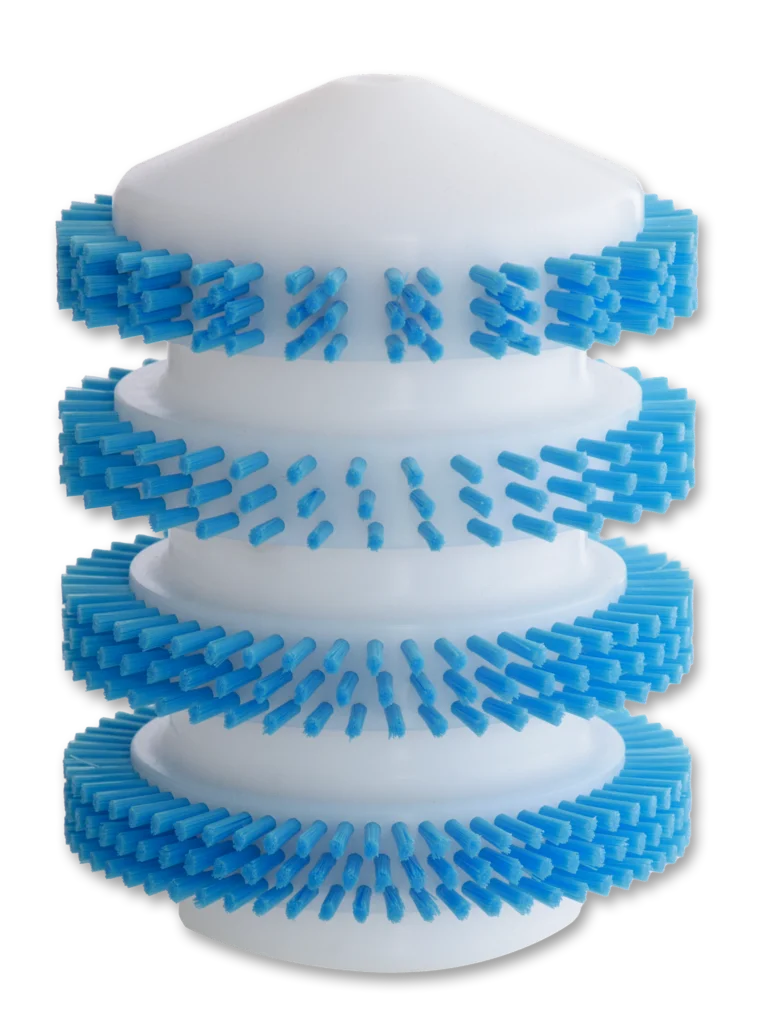
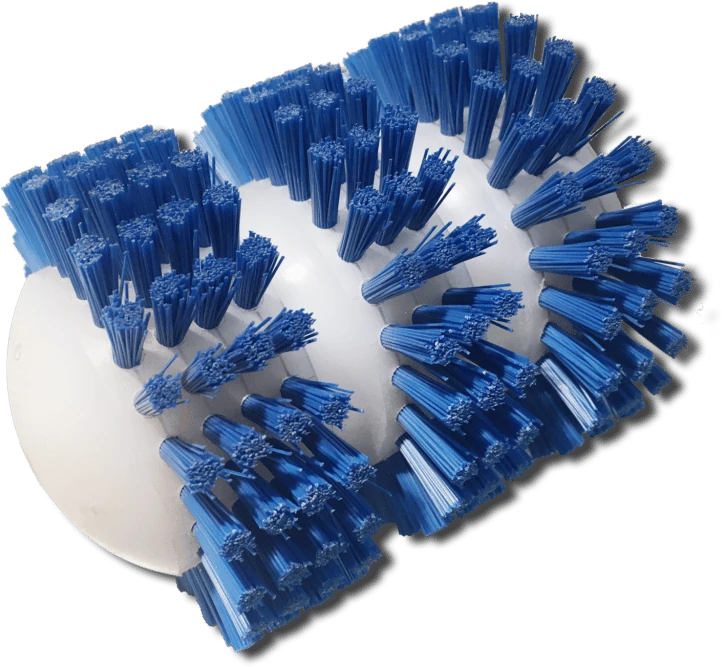
RATEC fixed pigs are robust, single-piece brush pigs that clean pneumatic conveying lines of dust, product residues, and deposits. They consist of a main body with firmly anchored bristles and are precisely manufactured for your pipeline and cleaning task. Fixed pigs are available as standard from DN 32, with bristles made of plastic, metal, natural fibers, or a combination thereof, and also in ATEX- and FDA-compliant versions upon request. RATEC develops and manufactures every fixed pig in-house in St. Veit an der Glan.
Table of Contents
How Fixed Pigs Work
- Launching: The fixed pig is safely introduced into the conveying line via a launching station.
- Cleaning Run: The propellant gas pushes the pig through the line. The bristles lie against the pipe wall and loosen dust, adhesions, and product residues. For a thorough result, we recommend several passes.
- Receiving: At the end of the line, the pig is gently received in a receiving station and removed without damage.
Fixed pigs clean pressure and suction conveying lines equally. The line does not need to be dismantled for this.
Why pig conveying lines?
Product residues are usually removed at the end of a conveying cycle by blowing out the pipeline. It is significantly more difficult to remove dust from pipe walls and product residues from dead spaces, such as gaps in flange connections or at diverters. In addition, there is angel hair, which are fine plastic threads that form on the pipe wall during the conveying of granules.
If such residues remain in the line, old material is carried over into the new batch during the next product change. In the worst case, the line slowly clogs or becomes blocked. A pig cleans the line from the inside, ensures clean product changes, and maintains constant conveying performance over the entire lifespan of the system.
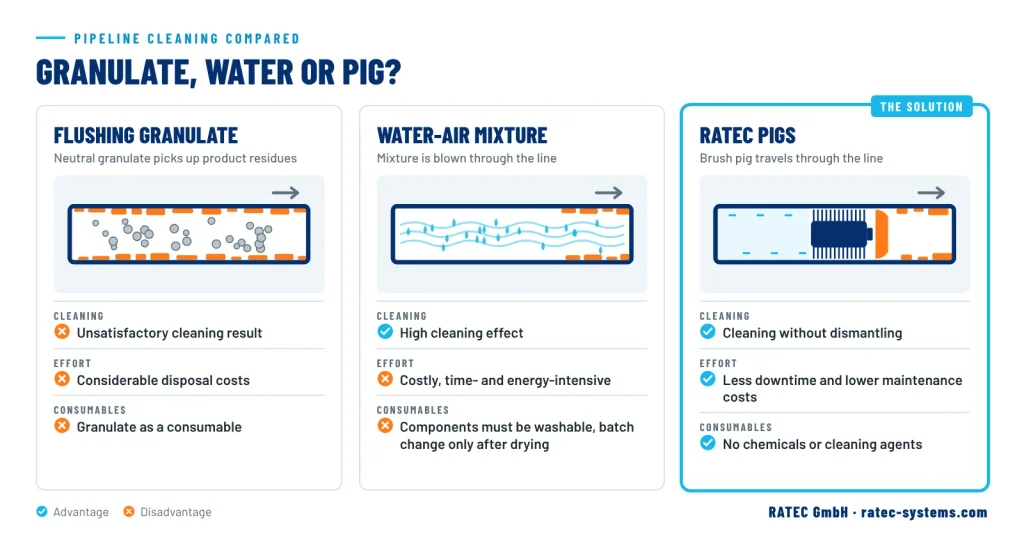
Common alternatives have disadvantages. Flushing granules are supposed to absorb the residues of the previous batch, but often do not clean satisfactorily and cause significant disposal costs. A water-air mixture cleans thoroughly but is expensive, time-consuming, and energy-intensive, requires washable components, and the next batch change is only possible after drying. Pigs, on the other hand, work dry, without chemicals, and without dismantling.
Bristle Material Suitable for the Task
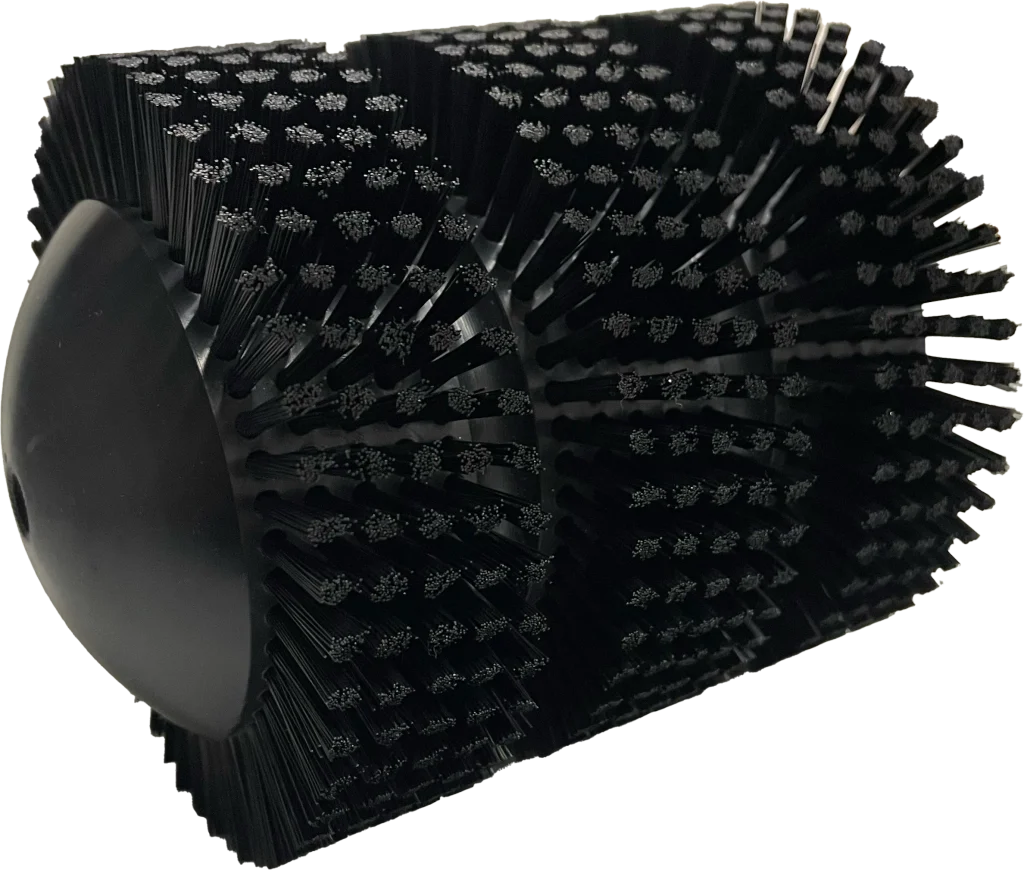
The bristles are the heart of every fixed pig. Depending on the conveyed material, deposits, and pipe material, we select the appropriate material:
- Plastic: for most cleaning tasks.
- Metal: for more stubborn adhesions.
- Natural fibers: for gentle cleaning.
- Combinations: when different properties are required in one pig.
For the food industry, we supply fixed pigs with FDA-compliant, product-contacting materials upon request. We always determine the material according to your requirements.
Technical specifications
| Feature | RATEC Fixed Pigs |
|---|---|
| Construction | one-piece, firmly bristled main body |
| Nominal diameter | from DN 32 (standard), other sizes on request |
| Pig speed | 1 to 3 m/s |
| Propellant gas temperature | +5°C to +80°C |
| Bristles | Plastic, metal, natural fibers or combinations |
| Conveying type | Pressure and suction conveying |
| Versions | ATEX- and FDA-compliant materials on request |
The values stated are our standard version. We manufacture other nominal sizes, materials and versions to your specifications.
Fixed Pig, Modular Pig or Turbo Pig?
Fixed pigs are the economical solution for clearly defined cleaning tasks. For other requirements, RATEC offers further designs:
- Fixed pigs: one-piece and robust, ideal when the cleaning task is clearly defined.
- Modular pigs: constructed from individual brush discs that can be exchanged and recombined.
- Turbo pigs: with counter-rotating turbine wheels for particularly thorough cleaning, from DN 125.
- Special pigs: for drying, polishing, for hoses, detectable, or for high temperatures.
When Pigging is Not Possible
Not every line can be pigged easily. Large diameter jumps, internal pipe installations, hard incrustations, and excessively large product quantities in the line are difficult. If your existing system is not piggable, we offer customized solutions and modifications to make it piggable.
Transmitting and Receiving Stations
A complete pigging system includes, in addition to the pig, a launching and a receiving station. They safely introduce the pig into the line and receive it gently at the end, without a hard impact. RATEC supplies the stations manually, semi-automatically or fully automatically with pig return systems, and also in the form of a diverter. You can find more information under Launching and Receiving Stations.
What matters during design
- Nominal diameter and line routing: DN, length, bends, diverters, and flange connections.
- Conveying method: pressure or suction conveying.
- Conveyed material and deposits: product, dust, angel hair, adhesions.
- Special requirements: ATEX, FDA, temperature, frequency of product changeovers.
- Degree of automation: manual, semi-automated or fully automated.
Where Fixed Pigs Are Used
RATEC pigs are used in almost all areas of pneumatic conveying in the bulk material industry, especially in the plastics industry, the building materials industry, the food industry, and the pharmaceutical industry. For potentially explosive areas, ATEX-compliant versions are available according to Directive 2014/34/EU.
Customized by RATEC
RATEC is at home in the bulk material sector and manufactures components for bulk material systems in its own plant in Carinthia, certified according to ISO 9001, EN 1090-1 and ISO 3834-2. From many years of experience in bulk material handling, we know what matters in conveying lines. Every fixed pig is designed for your pipeline, your conveyed material, and your cleaning task. An overview of all designs can be found under Pigs.
Do you want to keep your conveying lines clean?
Briefly describe your line, your conveyed material, and your cleaning task. We will get back to you with a concrete solution proposal.